-
Tenure, Talent, and the Temperature of an Organization
Published on 20250416
I spend a good amount of time with our legal team. Their office is down on the first floor of our building, and they’re not just essential to keeping us out of trouble—they’re also quick with a dry, often brilliant sense of humor. Lately, with some of our most senior and insightful legal professionals rotating through, their questions have become more abstract, bigger in scope—and more interesting.
One caught me off guard.
It came from our chief paralegal and centered on the civilian workforce in the Army Reserve. Specifically, what did I think about individuals holding positions for a long time? Did long-term tenure create risk, and were those risks worth the trade-offs?
It’s a great question. And, like many good questions, I didn’t answer it well in the moment.
My First Reaction: The 143d and the Southeast Workforce
When asked, I instinctively brought the question back to what I know best—our workforce at the 143d Expeditionary Sustainment Command. We’ve got 189 civilians spread across 13 southeastern states, supporting nearly 90 subordinate units and over 7,700 Soldiers. That number climbs every day as we adjust force structure and plug vacancies.
Having lived in Orlando for the past year, I understand why people want to stay put in the Southeast. No one wants to hop on a plane to reach a Battle Assembly. But preferences aside, the question still loomed: what are the implications—good and bad—of long-term civilian tenure?
The Power of Continuity
First, let’s be clear: continuity is an asset. Long-serving civilians provide stability as uniformed leaders rotate out every 2–3 years. Institutional knowledge builds over time, and there’s no substitute for repetition when learning a complex job.
I’ve experienced this firsthand. Decoding the Army Reserve Command budget took me years to understand. Long-tenured civilians—who’ve seen funding patterns, execution challenges, and systemic pitfalls play out repeatedly—are invaluable to shaping realistic strategies and keeping our formations moving.
They’re the ones who remember what broke the system last time and how we avoided (or didn’t avoid) disaster. That’s knowledge you can’t teach in a three-day turnover brief.
The Hidden Risk: Overreliance
But continuity can have a downside. A long-standing civilian often becomes the “default” answer to routine or burdensome tasks. Need someone to hold a Government Purchase Card? Ask the civilian. Need an alternate hand receipt holder or an additional duty manager? The civilian will be here longest, so give it to them.
It’s a rational decision, but not always a good one. It burdens key personnel, narrows institutional flexibility, and prevents uniformed staff from gaining experience critical to their professional development.
Worse still, we sometimes justify this lopsided distribution of labor by saying our Soldiers can’t access systems or aren’t around enough to be trained. That argument needs to be challenged.
The Perception of Power
The more nuanced concern raised by our chief paralegal wasn’t just about task saturation or stability. It was about power.
Specifically, when civilians remain in place for years—or decades—they often accumulate far more situational awareness than their rotating military counterparts. This dynamic can create tension, particularly when a civilian is more informed, more experienced, and perhaps more influential than the officer technically in charge.
I’ve seen this. I’ve lived this. And it’s why I constantly remind uniformed staff and commanders: you must lead with humility. You might be in charge on paper, but the person across the table may know far more than you do about the mission, the structure, or the politics.
You’ll only succeed by acknowledging what you don’t know, building partnerships, and treating your civilian teammates as peers, not subordinates.
Cultural Friction and the Need for Onboarding
Without deliberate onboarding and role clarification, these dynamics can breed friction. Misunderstandings about “who’s really in charge” erode trust and disrupt mission focus.
I’ve seen these tensions not only between senior civilians and rotating military supervisors, but also between longstanding junior employees and new leaders. When roles, expectations, and authority are left vague, power struggles tend to fill the vacuum—regardless of pay grade or time in service.
Senior managers must be proactive in onboarding new personnel and setting the tone early. That responsibility starts with me.
A Shifting Landscape: The End of the 35-Year Career?
One of our most respected teammates, Jim Williams, recently retired after 35 years. He was our supervisory IT specialist and key account manager—someone who knew every cable, system, and problem ticket across the facility. His retirement left a huge gap. But here’s the truth: I don’t think I’ll ever see another 35-year tenure in the same role before my own retirement. Not because people are less committed, but because the workforce itself is changing.
Younger employees are more mobile. They’re more likely to chase opportunity, flexibility, or purpose. And we shouldn’t fight that—we should embrace it.
A New Model for Civilian Talent Management
If we want to keep top talent and maximize its impact, we need to manage civilian careers more like we manage military ones. That means:
Structured career paths for our high performers Mobility incentives, like relocation support and targeted bonuses Deliberate placements into high-impact roles—HR, operations, logistics, IT, finance Real succession planning, not just backfilling when someone leaves
We’re already doing this on the uniformed side. We can apply the same principles on the civilian side, just on a slightly slower cycle—say every 5–7 years instead of 2–3. That way, we retain the benefits of continuity without the stagnation or burnout.
And most importantly, we empower our top 20%—the ones who can shape culture, drive performance, and build organizations ready for the future.
Final Thoughts
Tenure is a tool. Like any tool, it’s only effective when used with intent. In today’s Army Reserve, we can’t afford to rely on inertia to shape our teams. We need to shape them actively—by investing in our civilians, aligning talent with mission needs, and reducing the organizational heat through trust, humility, and smart leadership.
That’s where I’ll leave it for today. Thoughts from a morning ride, 7:04 to 7:22 a.m. (dictated/drafted during a morning commute)
-
No Rain
My first real job was in the summer of 1996 at the Lincoln Park District public pool. I was a lifeguard, earning the princely sum of $5.25 an hour—a whole ten cents above minimum wage. Just a 15-year-old kid with sun-in yellow hair and zero actual life-saving experience.
Now, I’m always a little surprised when I see beaches staffed with professional lifeguards—real adults with actual life experience—because where I come from, lifeguarding was basically just paid babysitting for 100 kids between the ages of 7 and 12.
My days were spent rotating between the lifeguard tower and walking laps around the pool deck, pretending to be vigilant while secretly counting down the minutes until the next swim break. When I wasn’t on duty, I’d be lounging in the sun, attempting gainers off the diving board, or hanging out in the office—probably doing a whole lot of nothing. I held that job for four summers, and thanks to the relentless loop of the local Top 40 radio station, I’ve got Sheryl Crow, the Goo Goo Dolls, Blind Melon and every other ‘90s chart-topper permanently etched into my brain.
The job was great, really. I made some solid friendships, even landed a couple of girlfriends, and it was definitely easier than the farm labor my buddies were stuck doing. But here’s the thing: every single day, I prayed for it to rain. Not because I hated the job or didn’t appreciate the paycheck, but because I always felt like there was somewhere else I’d rather be—something more important I was missing out on.
And that’s the lesson I took from my first job: quit praying for it to rain.
Life’s too short to wish away the days you’re living. Whatever you’re doing right now—whether it’s a summer gig, a 9-to-5, or just slogging through the mundane—be there. Show up. Because the rain might give you a break, but it also means you missed the sunshine.
-
What am I getting myself into
A co-worker recommended some books based on our discussions – go slower go longer
Category Book Title Description Goodreads Link Inspirational Stories: “Born to Run” by Christopher McDougall A modern classic that explores the secrets of the Tarahumara tribe and the joy of running. Goodreads Link Inspirational Stories: “Ultramarathon Man: Confessions of an All-Night Runner” by Dean Karnazes A motivational memoir from one of the most famous ultramarathoners, filled with tales of pushing human limits. Goodreads Link Inspirational Stories: “Finding Ultra” by Rich Roll The inspiring story of Rich Roll’s transformation from an overweight lawyer to a vegan ultra-endurance athlete. Goodreads Link Inspirational Stories: “Eat & Run” by Scott Jurek A mix of memoir and advice from one of the greatest ultramarathoners, emphasizing plant-based nutrition. Goodreads Link Inspirational Stories: “Running with the Kenyans” by Adharanand Finn A captivating account of living among and learning from some of the world’s best distance runners. Goodreads Link Training and Strategy: “Training Essentials for Ultrarunning” by Jason Koop A practical guide packed with evidence-based training advice for ultrarunners. Goodreads Link Training and Strategy: “Relentless Forward Progress: A Guide to Running Ultramarathons” by Bryon Powell A comprehensive and beginner-friendly guide to ultramarathon training. Goodreads Link Training and Strategy: “The Happy Runner” by David and Megan Roche A refreshing take on ultrarunning, focusing on joy and mental resilience over mileage. Goodreads Link Training and Strategy: “How Bad Do You Want It?” by Matt Fitzgerald Explores the psychology of endurance sports and the mental strategies that lead to success. Goodreads Link Fascinating Tales and Challenges: “North: Finding My Way While Running the Appalachian Trail” by Scott Jurek A gripping account of Jurek’s attempt to set the fastest known time (FKT) on the Appalachian Trail. Goodreads Link Fascinating Tales and Challenges: “Running the Rift” by Naomi Benaron A novel that intertwines a story of running with the history of Rwanda. Goodreads Link Fascinating Tales and Challenges: “A Race Like No Other” by Liz Robbins While focused on the New York City Marathon, the stories of perseverance resonate with ultrarunners. Goodreads Link Ultrarunning Culture: “Running with Sherman” by Christopher McDougall A heartfelt story of rehabilitating a donkey for an ultrarunning race, filled with humor and compassion. Goodreads Link Ultrarunning Culture: “The Rise of the Ultra Runners” by Adharanand Finn A deep dive into the ultrarunning culture and what drives people to push beyond the marathon. Goodreads Link Ultrarunning Culture: “Why We Run: A Natural History” by Bernd Heinrich An exploration of the evolutionary and physiological reasons why humans run, tied to Heinrich’s own racing journey. Goodreads Link -
2 years and 205.3
Ho-Ho-Holy Shit How has it been two years?
I don’t remember too much about 2023, but in 2024 we[1] moved to Orlando and we love it. We spend about as much time as you’d expect at Disney. Work is going well. Army is playing nicely[2].
In fact the only thing I’ve got sitting in the back of my head is that TITLE…
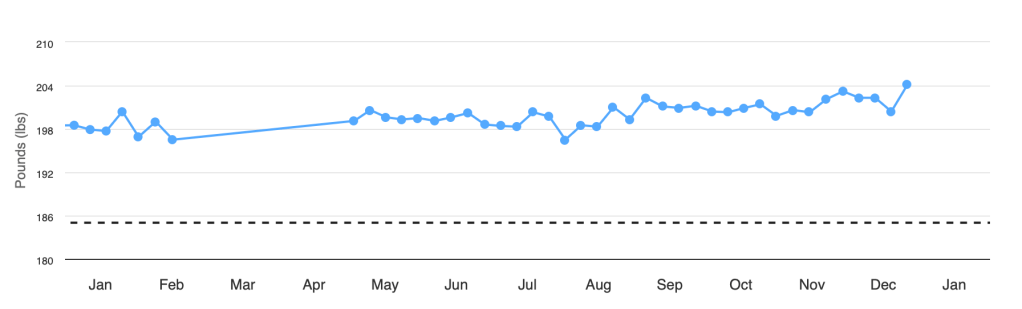
I’m seeing a trend[3], but this is the Year of Results[4] and it’s all about consistency.
- My wife (MY WIFE!), 5YO and 3YO
- Took a Training BN Command
- also that it took me two and a half months to put batteries in my scale
- Appraisal, Eval, Race, Scale
-
Area of Focus 3: Healthy Relationships
We got a sitter.
We went out for dinner.
We hid out at my out of town sister-in-law’s house and watched Netflix instead of going out for drinks after dinner.
Finding time to cultivate a healthy relationship and some much needed quiet time meant delaying a post I was working in today for tomorrow.
Worth it.
-
What I’m reading – Last Night in Montreal

The first in a series I call “What I’m reading” is more accurately “What I read” as this book is done-zo.
My first book of the year came on the heels of the last book of my year [1] and both are by Emily St. John Mandel. The former was Sea of Tranquility published last year, and the latter Last Night in Montreal even though the latter was written years prior to the former.[2]
This isn’t the most uplifting book, but the author[3] keeps the pace up, interest high and she provides immersive backdrops without losing the thread in unnecessary detail.[4]
Broken families, abduction, disappearance and revelation.
3 out of 5, but only because Sea of Tranquility was an easy 4 out of 5 and may elevate to a 5 out of 5 if it sticks with me.[5]
-
Watch this: Mark Lewis “5 Tips to Fast Track your New Year Diet & Training
5 Tips To Fast Track your New Year | Diet & Training
I’ve been watching Mark Lewis on YouTube for the past 9(ish) months. I started watching him with his COVID era Zwift content and have enjoyed his channel growth allowing him to focus more time and attention to his videos. Main points below, but the video, as with any I’ll post, is worth a watch.
1. The date doesn’t matter – start now – “immediately starting something good for you, is good for you. You will fail, and when you do you’ll rebound quicker
2. Friends and family – you’ll do fine without them, unless you’ve got the right one person to help
3. Create good habits – daily great habits are the only way to achieve goals unless your goal is to be a lump (why do British people call Google Calendar, Google Diary?)
4. Understand your limitations – admittedly I stopped paying attention and was looking at the group ride schedule for tomorrow on Zwift during this part of the video
5. Understand the science and implement it your own way – cut people some slack and worry about it yourself… no need to criticize
-
Goals for 23
Editors note, which is just me in the future… wait, more accurately, me in the present commenting on the past post. A bit of this comes off douchier than I like, but I’m running up against my boss’s (also me) deadline. I’ll be better, but I’ve tried to ‘reduce the douche’(tm) with footnotes.
As I mentioned yesterday, I’ve got three areas of focus (AoF) for 2023[1]. Though we[2] don’t believe in making resolutions, setting goals is an important part in giving me something to work towards while not setting myself up for failure. I’ve set a few goals in line with each AoF.
I signed up for a race in June[3] which will require consistent preparation to give me a reason to maintain my personnel health and fitness. To make getting up hills a bit easier and prevent too much wear and tear on my soon-to-be 40-year-old knees, I’d like to lose about 10 pounds.[4]
Consistently[5] slow weight loss requires me to be a bit more mindful of my eating.
Another AoF for my Year of Permanence will be to be a bit more deliberate with saving for our retirement and setting the girls up for financial success. I always feel a bit guilty when I spend money on things I enjoy, so this year every $1 discretionary spending will be matched with a $1 saved.[6]
And then their is the focus area of our relationship. Marriage, especially with two young kids, as Rihanna sang takes “Work, work, work, work, work.”[7] I’ve gotta outline a better goal for being respectful and grateful for my relationship with my wife.[8]
Finally, I’m going to spend some time in the future thinking about compound habits – those habits which tickle more than one area of focus. (eg. making food with my wife (MY WIFE!) in the evening leads to more deliberate choices, frees up cash from going out for lunch during the work week, and is an activity for us.)
Boom, goals.
- Health/Fitness, Finance, Relationship↩︎
- the royal we↩︎
- Ironman 70.3 Western Mass, the first year of the race and just 10 miles from my house↩︎
- or 4.5kg which to my dumb brain sounds easier↩︎
- fucking adverbs↩︎
- even the Dunkin – those girls are gonna be able to go to private school↩︎
- I gotta think more on this, without Rihanna or Arianna Grande’s SNL impression of Rihanna in my head↩︎
- more to follow.↩︎
-
Year of Transitions
I’m marching towards 40, just a couple months away in fact.[1] Last year around my February birthday I stumbled upon the concept of a yearly theme in this video.[2] I spent the last year with the concept of foundations in the back of my mind.
I chose to focus on knowledge, health and output. Because the concept of my year of foundations, I believe I successfully stuck to the habits of reading, pursuing a better level of fitness and better health decisions[3].
Last year I built foundations, and this year will be a year of transition. Earlier I mentioned an approaching milestone. The crest of a hill which I will be over soon. I’m excited to be 40 years old[4]. I love opportunities to reflect and plan a way forward, which is why I celebrate both the recent New Years looking at my personal life, and the annual fiscal year change over at work to look at my professional life[5].
This year I plan to figure out what do I want to do for the rest of my life. I want to transition to sustainable activities by refining my personal health and fitness goals while adding a couple new areas of focus. My areas of focus this year will include:
- Personal health/fitness
- Financial future
- Healthy relationships
I’ll be breaking these down in to goals and providing regular updates here all year.

-
New Year’s Resolve
During the holiday period, I powered through my back catalog of podcasts.[1]I stumbled across the RoadMan Cycling Podcast[2], who outlined three steps to creating a decent New Years’ resolution.
- Have a vision – write it down
- Have reasons
- Review daily
I think I’ve only sucsessfully stuck to one New Year’s resolution in the last 40 years.[3] I don’t disagree that he above steps would improve the odds for success, as the podcast host cited a study that 95% of people fail at their resolution by January 15.[4]
I do have a vision… making time to write more consistently to build skills that I’ll need when I retire, early. I do have reasons… a couple loud but undeniably cute reasons. I don’t review those long term resolutions daily., but as part of my weekly review I do.
So like last year, I’ll be setting a yearly theme. More on that tomorrow.
Happy 2023 everyone.
-
Subscribe
Subscribed
Already have a WordPress.com account? Log in now.
 Ben Sloot